|
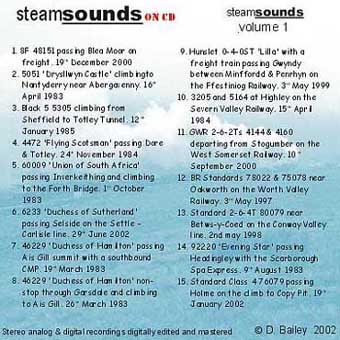
Track
List
Hear
near CD quality samples of track 1  ,
track
3 ,
track 6
& track 11 . ,
track
3 ,
track 6
& track 11 .
- With the successful completion of
much of the track refurbishment programme which culminated in a 4
week possession of the Settle to Carlisle line in November 2000 Railtrack
decided to mark the event and generate some rare positive publicity
for themselves by operating a steam hauled ballast train from Hellifield
to Carlisle using David Smith's 8F 2-8-0, 48151.
I have to admit that when I first heard about this I was sure that
it had to be a wind-up since Railtrack have never been particularly
pro-steam. However, on 19th December 2000 the train, reporting number
7P50, made up of 20 Dogfish wagons with a brake van at each end was
booked to leave Hellifield at 8.55 am taking the empty wagons up to
Ribblehead for loading with stockpiled ballast still remaining at
the temporary depot set up there.
The weather could have been worse, but not much, at least it stayed
reasonably dry but it was very dull and there was a moderate south
easterly wind which made recording a little difficult at times. Having
seen (and heard) the train passing Selside, where the 8F seemed to
be making relatively easy work of hauling the empty wagons we proceeded
to Ribblehead where, on arrival, the 8F and train had set back into
the siding at the west side of the station and loading of the wagons
commenced. As the train wasn't due to leave until 12.57 we had lots
of time (or so we thought) to go for a cup of tea.
Returning to Ribblehead at about 12.00 we thought that we would have
plenty of time to find a suitable spot somewhere near Blea Moor signal
box. However, as we walked up towards the box we were somewhat dismayed
to hear the unmistakable sounds of an 8F preparing to depart while
we assured each other that they were probably only shunting! It soon
became obvious that this was not the case so, it was out with the
recorder, find a bit of shelter and hope for the best - and only just
in time.
Since I was, for various (mainly financial) reasons unable to get
any recordings of my own in 'real' steam days it was nice to get this
one. Despite the conditions the recording that I got was excellent.
48151 is audible right from the start at Ribblehead and all the way
into Blea Moor Tunnel. Now with loaded wagons behind the tender the
8F sounds to be having to work far harder than it had at Selside especially
once off the easier gradients over Ribblehead Viaduct and on to the
1 in 100 gradient past Blea Moor Signal Box. And the weather was a
little brighter too. It would be nice to think that this sort of thing
might happen again one day. If it does, whatever the weather, I'll
be there!
Hear a
of track 1.
- On the 16th April 1983 GWR Castle 4-6-0
5051 'Drysllwyn Castle' was motive power for the bottom leg of a Welsh
Marches Pullman and gave us a run to remember.
After a reasonable climb to Llanvihangel the driver kept steam on
for some distance over the summit. The result of this was that we
shot through Abergavenny and recorded a max of no less than 82 mph.
And nothing fell off or melted!
Beyond Abergavenny another one of those annoying overhead bridge clearance
slacks brought the Castle down to walking pace at Penpergwm, the foot
of the climb to Pontypool Road. This recording starts as the loco
begins to accelerate on the 1 in 80 gradient beyond and ends at Nantyderry
where the gradient eases and there is yet another bridge slack.
- On 12th January 1985 the Humberside Locomotive
Preservation Group ran what was to be the first of a series of steam
hauled tours each featuring one of a selection of locomotives mainly
based in the north. Titled The Yorkshireman, the first of these was
hauled by Black 5 4-6-0 5305. Steam haulage began at Sheffield taking
in the Hope Valley route to Manchester where the train reversed before
continuing to York via Standedge and Leeds. Unfortunately, this and
the few subsequent trains were not well supported by the enthusiast
fraternity and the full series never materialised.
What a shame that so few passengers were on board to hear my favourite
Black 5 produce such an excellent sound on the 1 in 100 climb out
of Sheffield. This track begins with the departure from Sheffield
and ends in Totley Tunnel where the gradient begins to ease.
Note that the signalman wasn't quite fast enough for us. Approaching
Dore & Totley, where the line to Manchester diverges from the
main line to Derby and London, a HST heading for Sheffield passes
heading down the bank. Soon after, our driver has to close the regulator
and our speed falls from around 30 mph to half that figure before
the road is set for us and the signal ahead clears. Still, in view
of the sounds that 5305 makes in recovering from this check, I suppose
that I can forgive the signalman for being a little slow in setting
the road!
Hear a
of track 3.
- While I was being entertained by 'Clan
Line' & 'Raveningham Hall' on the Welsh Marches on 10th November
1984 others were getting a new route for steam in the book travelling
behind 4472 from Manchester to Spalding. This train was operated to
get 'Flying Scotsman' and some Pullman coaches to the London area
to provide no lesser person than the Queen Mother with a ride behind
the engine from Stratford to North Woolwich.
Having completed its Royal duties the loco returned north on 24th
November 1984 with The Fenman running from Spalding via Nottingham
to Sheffield and Manchester before continuing over Sough to Blackburn.
At least, that was the plan.
There wasn't much scope for noise until steeper gradients were encountered
west of Sheffield and, in this recording 4472 sounds well passing
Dore & Totley on the 1 in 100 climb from Sheffield and entering
Totley Tunnel with this 12 coach train.
On exiting Totley Tunnel after the recording has finished the train
was brought to a stand by signals at Grindleford. It appeared that
a Class 31 diesel on a preceding passenger train had failed and until
it was rescued we could not proceed.
This delay was fortunate for a few of our passengers who, having left
the station at Sheffield to take refreshment had lost track of time
and missed our departure. A fast taxi allowed them to catch up.
Eventually the failed train was rescued and we were able to continue
now rather late. Our late arrival in Manchester meant that a decision
was taken to terminate the steam haulage there and not run through
to Blackburn thus missing out on what should have been an entertaining
climb from Bolton to Sough.
- My first visit to Scotland for main line
steam was on 1st October 1983.
I had been told on many occasions about the exploits of A4 Pacific
60009 'Union of South Africa', a loco which I already had a soft spot
for as it was the first of the class that I ever saw, at York in 1964!
On this occasion the A4 was booked to work from Edinburgh to Aberdeen
and back with a charter which started at Newcastle. A rather long
day out as it turned out to be.
Near the end of the return journey No. 9 makes a fine sound climbing
the 1 in 70 gradient from Inverkeithing up onto the Forth Bridge.
By this time it was dark and the rain of cinders from the chimney
had to be seen to be believed, better fireworks than bonfire night!
- Although LMS Coronation Pacific 6233 'Duchess
of Sutherland' had been out and about on the main line for quite some
time, my first opportunity to see and hear the loco came on 29th June
2002 when it worked a train northbound over the Settle - Carlisle
line. Memories of 'Duchess of Hamilton' providing stirring performances
on this route gave hope for a dramatic recording but it seems that
rumours that the loco was usually worked easily proved to be accurate.
Even with 12 coaches behind the tender and travelling at around 40
mph the loco was only being worked in the first regulator valve and
was just 'chuffing' passing Selside on the 1 in 100 climb to Blea
Moor.
Hear a
of track 6.
- I will never forget the day when, arriving
at Carlisle to join a southbound Cumbrian Mountain Pullman, we were
somewhat surprised to find LMS Coronation Pacific 46229 'Duchess of
Hamilton' sitting in the middle road facing towards Glasgow! When
our train arrived from London the Duchess was attached at the north
end, which caused some speculation that this was to be a surprise
attack on Beattock! Sadly this wasn't the case. The train had left
London the wrong way round and Bernard Staite, at that time SLOA's
railtour organiser, was very particular as to who was in the front
coach so during the course of the journey so he had arranged for the
entire train to be turned at Carlisle. A Class 25 along with the Friends
of the NRM 55 Club Pullmans was attached at the rear and dragged the
train out to Upperby from where we were then Duchess hauled round
to London Rd. Jc. and regained our correct route.
Getting the train turned in this manner seemed pretty fantastic in
1983, it certainly wouldn't happen today - who cares which way round
the train is these days! Things were certainly different then.
The date was 19th March 1983 and later that day I was certainly glad
that the train had been turned. If it hadn't then I could have missed
getting this recording of 46229 reaching Ais Gill at about 45 mph
in a very creditable 23 mins 55 secs. Not bad with a 14 coach load.
- On the 26th March 1983 the Duchess went
back north over the S & C and we had a variation on the Cumbrian
Mountain theme. On this occasion the train, the Thames Eden Pullman,
started steam hauled from Sheffield with Black 5 5305 taking the train
as far as Leeds where, waiting to take over, was 46229 'Duchess of
Hamilton' and, at that time unknown to us, Holbeck driver Jim Melia.
After a satisfactory run out of Leeds and a water stop at Hellifield
Jim and the Duchess tackled the S&C.
We passed Settle Jc. at 62 mph and after a minimum of 42mph approaching
Helwith Bridge Jim decided to give us a run for our money. On the
gradient up to Horton speed rose to over 50 mph and remained at around
52 mph all the way to near Ribblehead where the loco was eased for
the slack over the viaduct. An excellent performance!
But Jim wasn't finished with us yet. Having taken water at Hellifield
there was no need to stop at Garsdale and we ran non stop to Appleby.
As this recording starts we are approaching Garsdale station at a
little over 60 mph. Soon after passing the station Jim opens the engine
up to tackle the final climb to Ais Gill. On the short falling gradient
onto Dandry Mire viaduct speed rises slightly to 68 mph which is maintained
through the two short tunnels before rising to a little over 70 mph
at Ais Gill summit! Beyond Ais Gill the run the run down to Appleby
was no less exciting with the speed above 70 mph for much of the time
and a max of no less than 77 mph approaching Ormeside. At this time
on the S&C (which was a 60 mph railway) this sort of running was
quite without precedent.
Jim had a young volunteer fireman by the name of Phillips with him
on this occasion. This young man had had very limited steam experience
and this was his first time on the S & C with a steam hauled train
so it was probably just as well that Kim Malyon from the NRM was on
the footplate and able to do the firing for most of the run. I understand
that on returning to Leeds Mr. Phillips had his name taken off the
volunteers list. Perhaps he thought that steam hauled runs were always
going to be like that!
- Locomotives come in all shapes and sizes.
We have just heard a few tracks of one of the largest and most powerful
classes of locomotive in the country so let's try something at the
other end of the scale.
Over the 1999 May Bank Holiday weekend the Ffestiniog Railway held
a Gala. Unless the weather has been wet and the line side is well
damped down coal fired locos are banned from running beyond Penrhyn
or Rhiw Goch, the risk of starting fires in the forestry beyond is
considered too great.
As the weather in the few days preceding Monday 3rd May 1999 had been
particularly fine the goods train, which was to return to Minffordd
by gravity was not allowed to proceed beyond Penrhyn. It was hauled
up to this point by the diminutive Hunslet 0-4-0ST 'Lilla' which had
spent the previous two days giving footplate rides at Boston Lodge.
However, don't judge locos by size alone as this loco makes enough
noise to pass for something much larger!
This recording was made at Gwyndy, mid-way between Minffordd and Penrhyn
and the loco makes a fine sound climbing the 1 in 82 gradient. To
say that I was impressed with the noise that this little loco produced
would be something of an understatement. As they say, it isn't size
that matters…………… !
- Many preserved railways hold Enthusiast
Weekends. All too often these are not quite as entertaining as one
might wish but one railway which can usually be guaranteed to put
on a good one is the Severn Valley Railway and the event held in Spring
1984 was no exception.
Highley station can be a very interesting place during these events
and there was certainly plenty happening in the early afternoon on
15th April 1984. In this recording we hear Collett 0-6-0 3205 arriving
from Arley with a short freight. Once the freight is safely in the
siding another Collett loco, large Prairie tank 5164 departs for Bewdley
with the Severn Valley Limited.
- Another railway that nowadays has a good
reputation for enthusiast events is the West Somerset Railway who,
in 2000, held their usual three day Autumn Enthusiast Weekend on 8th,
9th & 10th September.
On the first day, Friday, the weather was not good, in fact there
was light rain for most of the day. So, instead of the lineside spots
I had intended to visit I was forced to get my money's worth out of
my Rover Ticket and spent the entire day on the trains. Saturday was
only a little better so it was not until Sunday that I was able to
get out on the line side with my recorder.
One of the features of this event was the presence on the railway
of three large Prairie tanks, a type of locomotive that regularly
worked on the line in GWR & BR days.
One of my favourite stations on the line is Stogumber and in this
recording two of the three 2-6-2 tanks, 4144 and 4160, are heard starting
on the 1 in 68 gradient out of the station and the accelerating on
the ensuing 1 in 100 and heading for Crowcombe in fine style.
Hear a
of track 11.
- 3rd May 1997, as well as being my birthday,
was the first day of a three day enthusiast event on the Keighley
& Worth Valley Railway and I spent the day at the top of the embankment
between Damems Loop and Oakworth making sound recordings and enjoying
the spring sunshine.
The KWVR could almost have called it Standard Weekend as, aside from
the Jubilee 'Bahamas', all the locomotives in use on passengers trains
were BR Standard classes.
With a mid afternoon train for Oxenhope BR Standard Class 2 2-6-0
78022 and BR Standard Class 4 4-6-0 75078 are heard deaparting from
Damems Loop and climbing the 1 in 60 gradient to Oakworth with a six
coach train.
- Ever since I had first travelled on the
line I have always wanted to have a steam hauled run through the Conway
Valley to Blaenau Ffestiniog and, indeed, I still do!
On 2nd May 1998 the first of two steam hauled trains, the Conway Climber,
ran from Chester to Bleanau Ffestiniog.
After a trouble free bunker first run from Crewe and after reversing
at Llandudno Jc. we set off up the Conway Valley behind BR Standard
Class 4 2-6-4T 80079 with 6 well filled coaches behind the bunker.
The steeper gradients on this line do not start until after Betws-y-Coed
and not long after passing that point we hear the Standard Tank going
well approaching the viaduct over the Afon Lledr and accelerating
on the easier gradients over the bridge. Climbing once again through
the woods beyond 80079 sounds as well as I have ever heard it until
approaching Pont-y-Pant, where this recording ends, things start to
go wrong.
While we were stood at Llandudno Jc. a railway man there on hearing
that 80079 was taking 6 coaches up to Blaenau Ffestiniog was heard
to remark that, with that load we wouldn't get past Milepost 19!
Well, sadly, he was absolutely right. That was exactly where we were
brought to a stand.
It wasn't bad rail conditions that caused the train to slip to a stand
but having 6 coaches strung out round extremely tight reverse curves
with the wheels binding on the check rails. It soon became apparent
that, no matter what the crew tried we were going no further and we
eventually reversed to Betws-y-Coed to await the arrival of a diesel
to drag us back to the Junction.
- 1983 was the year when we really started
to get to know the York drivers who were to entertain us for the next
few years with their exploits on the Scarborough Spa Express. Some
drivers we got to know more quickly than others. One driver in particular
we soon became familiar with and looked out for was Harry Wilson.
Now some, myself included, could occasionally be heard to criticise
Harry's style (if that is the right word) of enginemanship but one
thing that no one could argue with was the fact that, whatever he
did, we were never bored!
Take the evening of 9th August 1983. Harry had the BR Standard Class
9F 2-10-0 92220 'Evening Star' for the evening circle from York and
we had had a badly checked run from York to Leeds which featured a
max of over 70 mph before Church Fenton. A further signal stop leaving
Leeds ruined any chance of a record up to Horsforth and, as this recording
begins we are dawdling across the viaduct at Kirkstall with the safety
valves roaring for all they are worth. On the train we were wondering
what Harry was playing at since we now had a clear road. As we approach
the far end of the viaduct, Harry opens the engine up and the safety
valves soon close. I recall that the ensuing acceleration felt more
like that of an EMU than a steam loco! By the time the train has passed
through the short tunnel at Headingley speed has risen to almost 50
mph. Beyond Headingley, where this recording ends, speed continued
to rise to a max of 56 mph before reaching Horsforth.
The average speeds tell their own story; 27½ mph from Wortley
Jc. to Headingley then 54 mph from there to Horsforth! The time from
Wortley Jc. to Horsforth was just 2 secs. over 7 mins.
Harry had the same loco for the evening circle two days later and
put in a time faster by over 30 secs. from Wortley Jc. but without
reaching 50 mph! At that stage in the season that run was the record
both for Leeds and Wortley Jc. to Horsforth. As I said, Harry is never
boring!
- Blame Foot and Mouth. Blame it for the
fact that this recording, made on 19th January 2002, was the first
line side recording I had made for almost 6 months.
The occasion was BR Standard Class 4 2-6-0 76079 working a train called
The Pennine Way which took in a circular itinerary from Preston which
included the climb over Copy Pit.
This recording was made about half way between the site of Cliviger
signal box and Holme Tunnel not far from the site of Holme station.
The loco is heard approaching having recovered some speed on the 1
in 185 gradient through Towneley Tunnel and going very well at the
head of 8 coaches. Now back on a gradient of 1 in 68 speed begins
to fall as the train passes and continues to fall on the continuing
gradient towards Copy Pit summit.
Well, worth waiting almost 6 months for!
|